.png)


Is the Camino still Catholic? Faith, Friction, and the Heart of Pilgrimage
- Apr 30
- 3 min read

I didn’t expect the question to stay with me, but it did.
“Is the Camino still Catholic?”
It came up in conversation after someone shared a few stories they’d heard. Stories about crowded trails, mixed motives, people walking it more for the experience than the faith. Nothing said with judgment, just a kind of curiostiy. And I realised I didn’t have a quick answer.
The Camino de Santiago has always drawn a wide mix of people. For centuries, men and women have set out toward the shrine of Saint James carrying all sorts of intentions: faith, doubt, grief, curiosity, or simply the need to step away from the pace and routines of ordinary life. Some walk with great faith, others aren’t sure what they believe anymore, if anything at all.
But something happens out there on the road.
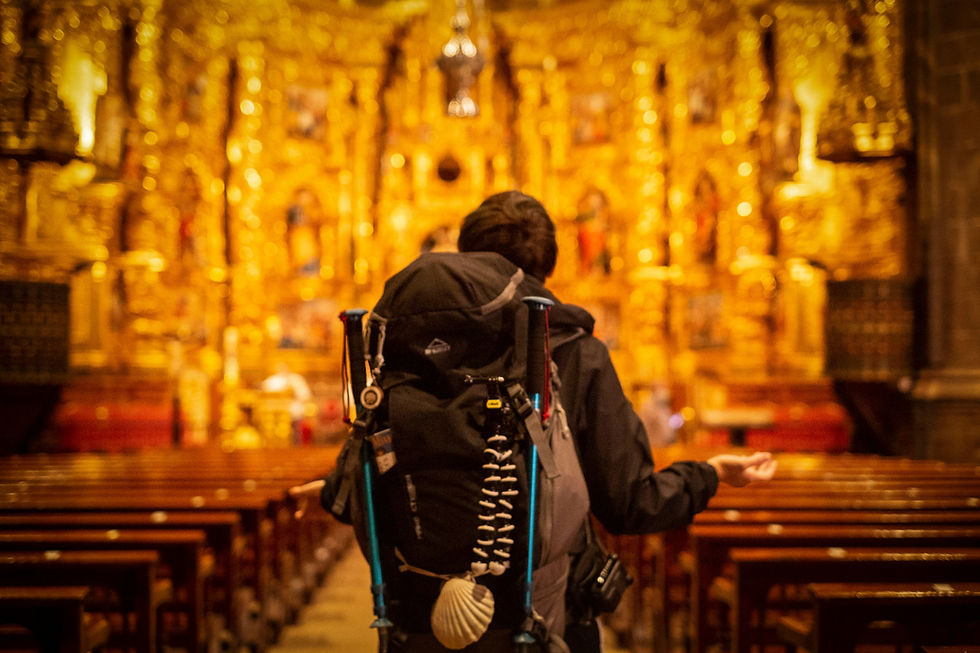
Maybe it’s the rhythm of walking. Maybe it’s the long stretches between towns, or the way conversations open up more easily with strangers. Distractions begin to fall away. You notice things you’d normally miss; like how your body settles into its natural surroundings, how your mind starts to clear and then deepen.
And then, almost without meaning to, you find yourself facing the questions you’ve kept at a distance. You look back on the path you’ve been on, and the turns you’ve taken (or the ones you didn’t take). Something in you begins to take shape, to feel more whole, more honest. And whether you’d describe it in spiritual terms or not, there’s often a sense that something deeper is beginning to move.
So, is the Camino still Catholic?
Of course it is. But I think the better place to begin is here: what kind of space has the Camino become? And what does it invite people to discover when they walk it?
The Spanish mystic St John of the Cross offered a gentle but firm caution about pilgrimage:
“When a great multitude is making a pilgrimage, I should never advise him to do so,
for as a rule people return on these occasions in a state of
greater distraction than when they went"

For St John of the Cross, the value of the pilgrimage was not in the popularity of it. Nor was it in the distance travelled or the places visited, rather the true value is in the devotion carried within the heart. Without that interior focus, even the most sacred road can become just another trip.
And that tension is something many modern pilgrims experience. The Camino today can feel commercial in places. Crowded hostels, souvenir shops, and a steady flow of walkers with very different intentions. Not everyone walking beside you is there for faith; some come for sport, others for culture, others simply for the adventure.
For Catholics, this can be disorienting. It may feel like the sacred (and original) purpose of the pilgrimage is diluted.
But in truth, this diversity is nothing new. Even as far back as Geoffrey Chaucer’s The Canterbury Tales, it is recorded that pilgrims have always been a mixed company; people of different backgrounds, beliefs, professions, and moral standings. What united them was not uniformity, but the shared road. Each carried a story. Each walked for reasons both noble and flawed.

The same is true on the Camino today. You may walk beside people whose lives and beliefs differ greatly from your own, but you are united in the act of journeying. There is something profoundly human, and sacred, about that shared movement toward a destination.
For Catholics, the key is not to control the environment, but to shape one’s own heart. As St John of the Cross reminds us, devotion is what transforms a walk into a pilgrimage. It is the difference between simply arriving and truly encountering God along the way.
Perhaps, in the end, the question isn’t simply whether the Camino is still Catholic? I mean, was it ever? The more revealing question to ask is a personal one: am I Catholic, and what does that mean for the way I walk this road?
Because the Camino does not shape faith on its own; it reveals it, it tests it, and sometimes deepens it. And the call is not only to be a Catholic on the Camino, but to let the way we walk - faithfully, attentively, with charity - carry into every other road we travel.
This is why at JC Journeys, devotion is placed at the centre of every pilgrimage experience. The road is not just something to complete, but something to live prayerfully. Through daily Mass, times of silence and reflection, shared and individual prayer, and engagement with Scripture, pilgrims are invited to journey with intention, and to explore deeper their faith.



Comments