.png)


The Great Pilgrimage of Egypt
Many of us could be forgiven for thinking of the Holy Land as confined to present-day Israel and Palestine. Yet the story of salvation unfolded across a far wider landscape than those borders suggest. The lands made holy by God's saving work encompass much of the modern Middle East, including Jordan, Syria, Lebanon and, perhaps the most accessible and remarkably well-preserved destination for many pilgrims, Egypt.
For Christians, Egypt occupies a unique place in salvation history. It was the land of the Exodus, where God revealed His power through Moses and led His people towards freedom. It was the wilderness of Sinai where the Lord gave the Ten Commandments and entered into a covenant with Israel. It was also the place of refuge chosen by Divine Providence for the Holy Family when they fled from Herod. Few countries can claim such a profound connection to Sacred Scripture.
Our pilgrimage through Egypt and Sinai combined prayer, daily Mass, ecumenism and discovery, allowing Scripture to come alive. Over seven days, we followed in the footsteps of Moses, visited places associated with the Holy Family, encountered the rich traditions of Eastern Christianity, and discovered why Egypt deserves to be considered one of the great pilgrimage destinations of the Christian world.

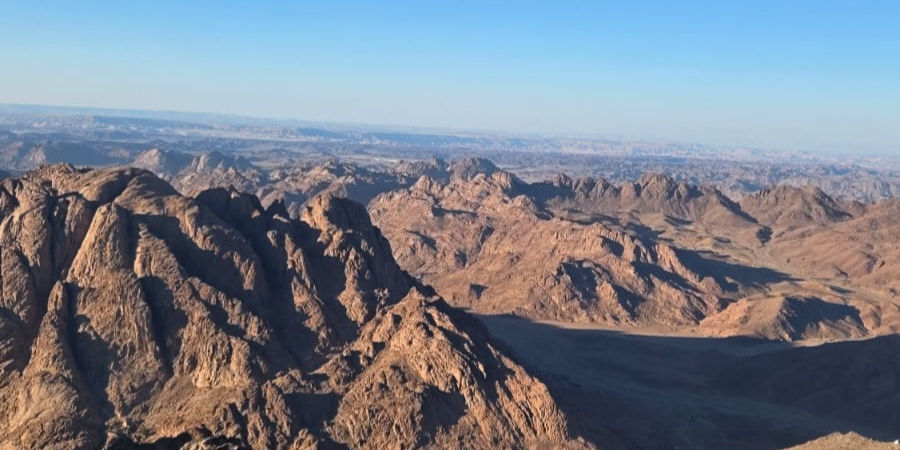
Leaving Cairo and crossing beneath the Suez Canal, we entered the Sinai Peninsula and, in a sense, the landscape of the Book of Exodus itself. Our route took us through places associated with Israel's journey from slavery to freedom, including the oasis of Wadi Feiran, traditionally identified with Rephidim, where Moses raised his arms in prayer while Joshua led the Israelites into battle. As the desert stretched endlessly before us, the biblical narrative felt less like an old story and more like a journey rooted in real places and real geography.
It brings to mind the words of St Jerome:
"Five gospels record the life of Jesus. Four you will find in books and the one you will find in the land they call Holy. Read the fifth gospel and the world of the four will open to you."
St Jerome, 4th Century
Our destination was St Catherine's Monastery, at the foot of Mount Sinai, the oldest continuously inhabited Christian monastery in the world. Founded in the sixth century by the Emperor Justinian, it remains a living centre of monastic life. Entering the monastery with the monks, we encountered treasures of Christian history: the famous sixth-century icon of Christ Pantocrator, one of the earliest surviving images of Christ; precious manuscripts, including pages from the Codex Sinaiticus; and beautiful icons depicting Moses before the Burning Bush.

We were granted the privilege of veneration in the chapel built over the traditional site of the Burning Bush, where God revealed himself to Moses. Standing in this sacred place, we found ourselves at the very heart of the Exodus story. Nearby is Moses' Well, associated with his encounter with Zipporah and the family of Jethro, another ever present reminder that the events of Scripture are woven into the fabric of the monastery and the surrounding landscape.
Later, after joining the monks for Vespers, we climbed to the monastery roof and looked out across the beauty of Sinai. From this vantage point, we could also see the growing tourism developments advancing into the valley, a visible reminder of the challenges facing the monastery today. Yet this ancient community is no stranger to adversity. For more than fifteen centuries, the monks of St Catherine's have navigated changing political, religious, and social landscapes while preserving their unique way of life.

Signs of this remarkable history can be found throughout the monastery, including an eleventh-century mosque built within its walls. Although no longer in use, it stands as a striking testament to the tradition of coexistence that has long characterised this remote corner of Sinai. That spirit endures in the close relationship between the monks and the local Bedouin community, many of whom regard themselves not simply as neighbours, but as custodians of the monastery and participants in its living heritage.

A fitting conclusion to our visit to St Catherine’s Monastery was a special tour of its remarkable library, one of the most important collections of Christian manuscripts in the world. Recently restored and modernised through the support of the St Catherine Foundation, whose work we are proud to support, the library stands as a testament to the monastery’s enduring commitment to preserving the treasures of the Christian tradition. To see at first hand some of the manuscripts that have been safeguarded here for centuries was a privilege and a memorable way to bring our time at this extraordinary holy place to a close.

Returning to Cairo, our focus shifted from the story of Moses to that of the Holy Family. Egypt's importance in salvation history can scarcely be overstated. Mentioned more than seven hundred times in Sacred Scripture, it appears throughout both Testaments as a place of trial, refuge, deliverance and divine providence. The prophet Hosea wrote, "Out of Egypt I called my son" (Hos. 11:1), words later fulfilled when St Joseph brought Mary and the Child Jesus into Egypt to escape Herod's persecution (Matt. 2:15).
In Old Cairo, we visited several churches associated with the Holy Family's time in Egypt, including the Hanging Church and the ancient Church of St Sergius and Bacchus, built above a crypt where tradition holds that the Holy Family found shelter. These sites are not merely historical monuments but places of active worship, linking the biblical past with the living faith of Egyptian Christians today.

That living faith was evident throughout the journey. Egypt is home to one of the oldest continuous Christian communities in the world, with around twelve million Christians, the majority belonging to the Coptic Orthodox Church. While separated from Rome since the Council of Chalcedon in AD 451, they have preserved a rich Christian heritage stretching back to the earliest centuries of the Church. Alongside them are the Coptic Catholic Church and several other Eastern Catholic Churches in communion with Rome. Our conversations with local clergy, culminating in a meeting with Bishop Claudio Lurati, offered valuable insight into the diversity and vitality of Christianity in modern Egypt.
The pilgrimage also introduced us to other facets of Egypt's remarkable history. A visit to the Pyramids and the Grand Egyptian Museum provided a glimpse into the civilisation that formed the backdrop to so much of biblical history. Yet while the monuments of the Pharaohs remain impressive, it was the witness of Egypt's Christians that left the deeper impression.

Perhaps nowhere was this more evident than at Cairo's extraordinary Cave Church in the Mokattam Hills. Carved into the mountainside and capable of accommodating thousands of worshippers, it stands above one of the city's poorest districts. There, amid striking surroundings, we encountered a vibrant Christian community whose faith and perseverance continue to bear witness to Christ in the very land that once sheltered the Holy Family.
As our pilgrimage concluded with Mass celebrated alongside local Catholics, it became clear that Egypt is far more than a destination of historical interest. It is a living chapter in the story of salvation. A fifth gospel, worthy of reading. From the Exodus and Mount Sinai to the flight of the Holy Family and the witness of today's Christian communities, Egypt offers a rare opportunity to walk through the pages of Scripture while encountering a faith that continues to flourish against all odds.

For those seeking a pilgrimage that combines biblical history, ancient Christian tradition and the witness of living faith, Egypt remains one of the most rewarding journeys a Christian can make.


Comments